Wavelengths and Energy Calculations

This lesson had something very rare. It contained some information that I had prior knowledge about. I cannot remember a lesson where I could recall knowing something that I had previously learned before. This information was the basics of wavelengths. The good ole spectrum that listed the wavelengths in order of smallest wavelength / most energy to the least energy / longest wavelengths. It was quite refreshing to see something familiar, but with that came many new things. Calculating energy and wavelength with frequency didn't seem to difficult, but all of the equations got confusing and could sometimes be hard. In conclusion, this is still my favorite unit, and it is still fairly simple.


Calculation Help

Very Useful Source For Entire Lesson And The Electromagnetic Spectrum


http://9-4fordham.wikispaces.com/file/view/em_spectrum.jpg/244287321/em_spectrum.jpg

Spec. 20 Lab

Yawn. Oh sorry, I just got done with the Spec. 20 Lab. That lab was almost as exciting as my nap. I had a dream that I was sitting in class watching a knob get twisted left and right, left and right for what seemed like a couple years. This lab was the exactly the opposite of the Flame Lab. Hey, I guess they all can't be as exciting as color changing flames. We collected a bunch of pointless information regarding transmittance percentage and absorbance after redundantly recording way too many numbers. I pray that we leave labs like this in the past, and do something more exciting from here on out.

Info About Transmittance And Absorbance

Periodic Trends


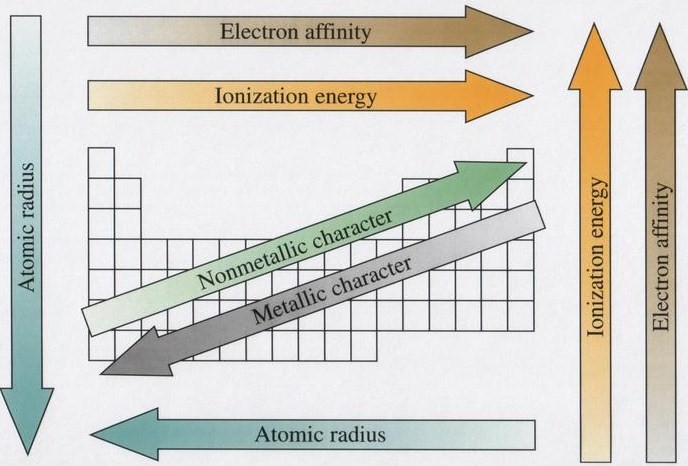
The final lesson before our big unit test concerned me a bit at first. Throughout the lecture I thought that this lesson was very hard. After reviewing it over, I realized there was only one huge key concept that you needed to remember. That was this magical little picture / graph showing the periodic trends and which way they increased based on the periodic table. It had them all: ionization energy, electron affinity, metallic characteristics, and the atomic radius. All of these trends were very important, but you really only needed to know which elements would be more or less compared to each other based on the direction of those trends.

Fantastic Source To Better Understand Periodic Trends 


http://upload.wikimedia.org/wikipedia/commons/4/41/PERIODIC_TRENDS.jpg

Flame Lab

http://ih0.redbubble.net/image.25458624.7071/flat,550x550,075,f.jpg
This was by far the coolest lab we've done yet. Seeing the fire change colors was extraordinary. I've never seen anything like it. It was like magic inches from my face. I hope to do more labs with fire in the future.


New Unit, New Me

I am putting the last two units behind me. Let's just say that the last two units resulted in the words grades I've ever seen in my life. The test scores I was getting were unheard of. I am really going to work hard for every thing in this class. I am going to put way more effort into making sure I thoroughly understand every concept of every lecture. I will study harder and more than I ever have before. I have to get my abysmal grade up, it's not a option.

http://media-cache-ec0.pinimg.com/736x/62/ca/32/62ca3261296d6572ed9558822f10cceb.jpg

Terrible Is An Understatement

Boy oh boy.. How am I supposed to describe this test. I cannot think of a word that would accurately describe this poor of a result. When I asked my pals to guess how bad my score was, they would say 60% or maybe 50%. You can get a sense of how bad I did when I tell you that I would've been throwing a party if I got a 50%. Maybe I should pick a higher lucky number or something because I got my football number. A 22%.... I have no more words. Just throw this one in the trash physically and mentally and move on.

http://www.anr.state.vt.us/dec/wastediv/solid/urs/images/trash.jpg


Arrhenius Acids and Bases

This lesson was jam packed with important information. It was a lot to take in, but I think I understood it pretty well.
The products are the same in Arrhenius acid/base reactions, a salt and a water. The strength of the salt is determined by the strengths of the parent acid and base. The compound "salt" is formed from the anion of an acid and the cation of the base.
Water can act as an acid because it can donate a proton, and it can act as a base because it can accept a proton to form the hydronium ion. An equilibrium is established in the process called, the auto-ionization of water. We then had to calculate the H+ and OH- required for certain examples, which was a bit easier than I thought it was going to be. An overall pretty good lesson.

Details About Arrhenius Acids/Bases

Very Useful Documents Over Calculating H+ and OH-